How Different Wrapper Leaves Affect Fermentation and Aging Performance
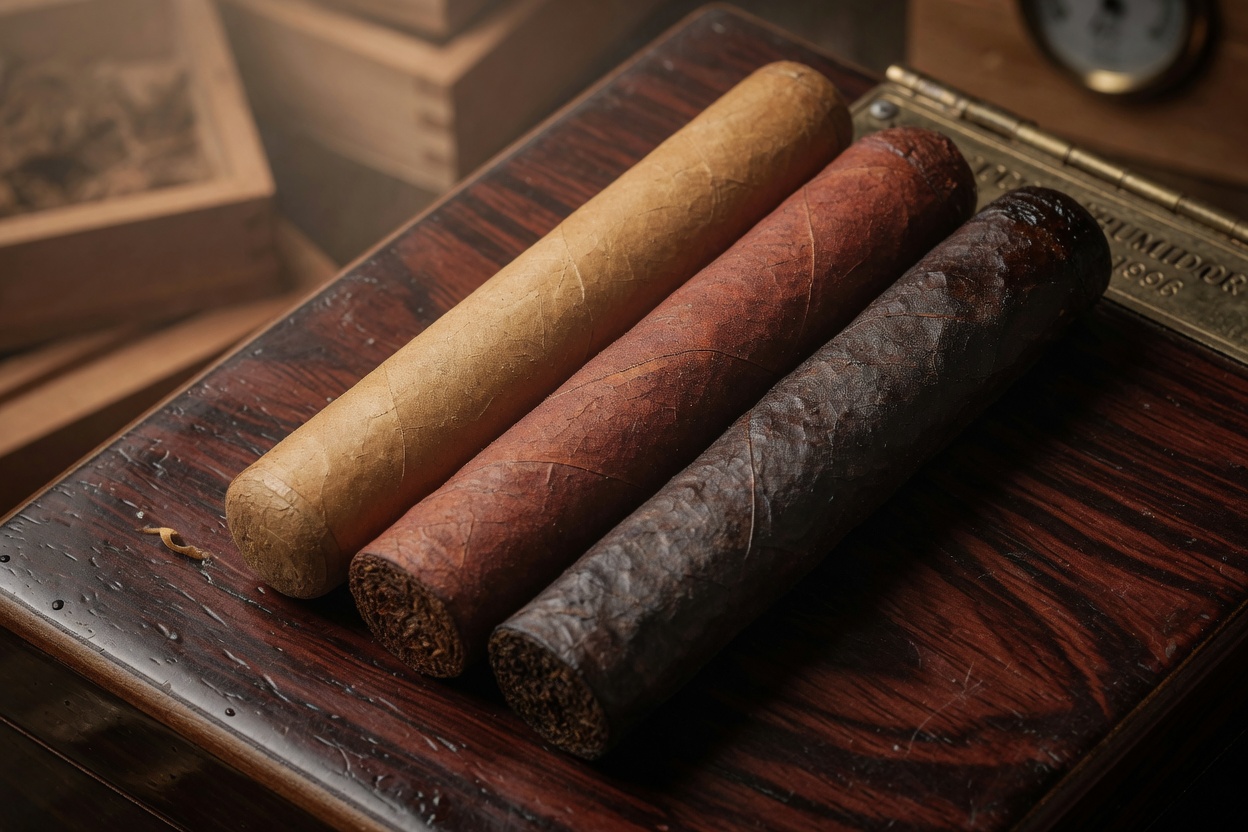
In March 2023, I conducted a very "frugal" controlled experiment in my humidor set at approximately 65% RH, 18–19°C: the same batch of Nicaraguan central filler blend, the same size about 50 ring gauge × 5.5 inches, changing only three wrapper types—Ecuador Connecticut, Nicaraguan Habano, and a Broadleaf Maduro that went through an extra deep fermentation path. 6 sticks of each group were kept, the rest were smoked immediately, and the remainder was opened for cold aroma inspection and test smoking at 0 months, 3 months, 6 months, and 12 months.
At the six-month mark, the differences among the three groups were not "the strength suddenly doubled," but rather the narrative track shifted: Connecticut's cold aroma was still hay, cream, and light cedar, the first third as clean as unmelted butter; Habano's cold aroma added pepper and dry leather, with earth and wood grip by the first third; Maduro's cold aroma was cocoa husk, wet coffee grounds, and a hint of molasses, with almost no ammonia smell, but if burned a bit fast, the tail would reveal a bitter wood note like "over-toasted bread crust."
Same filler, only different wrapper—different chassis left by fermentation, different "valves" for moisture and oxygen during aging, and ultimately the speed and direction of flavor evolution are tuned to different scales. The wrapper is not a color label on the poster; it is the chemical-physical boundary of the entire cigar.
Below I focus on one thing: how different wrapper leaves participate in and influence flavor evolution after fermentation and aging. The craft explains the taste, without rewriting tobacco's health properties.
I. First, Pin Down the Position: What the Wrapper Controls in the Whole Chain
Simplified chain:
Shade/sun growing → Harvest leaf selection (most intact, thinnest, least insect damage)
    ↓
Curing (air/sun drying) → Resweating
    ↓
Wrapper-specific fermentation (often milder, boxing/small piles common) or thick leaf/deep fermentation path
    ↓
Grading, packing, warehouse aging (in public accounts, wrapper leaves are often aged at least about 6 months)
    ↓
Resweating and rolling → Post-roll equilibration → Box/humidor continued micro-fermentation and aging
The industry often says: wrapper contributes about 30%–40% of the flavor impression, especially cold aroma, first puff, and burn appearance. This number is not an ISO standard; it's more like the empirical magnitude from cigar rollers and tasting circles—I accept it as a "weight hint" but don't treat it as a lab constant. The truly harder facts are:
- When burning, the outermost layer that heats up first and releases volatiles first is the wrapper;
- During storage, moisture and oxygen first penetrate through the wrapper;
- During fermentation, thin leaves and thick leaves can withstand different pile temperatures, moisture levels, and durations.
So my basic view is: discussing the wrapper's effect on aging must start from what fermentation it underwent at the leaf stage, not just from the color depth after rolling.
II. How the Wrapper "Participates" in Fermentation: Thickness, Oils, Sugar-Nitrogen, and Contact Surface
1. Not All Leaves Can Enter the Same Pile Logic
Conventional cigar tobacco fermentation methods include pile fermentation (pilón/bulk), box fermentation, barrel fermentation, medium fermentation, etc. The public craft descriptions have a very practical division: box fermentation is more commonly used for wrappers and binders—because the outer leaves need to preserve integrity and elasticity, and cannot be roughly piled at high temperature repeatedly like filler leaves.
In the public process descriptions of Cuban shade wrapper, it's common to see statements like "thin and fragile, often only needing one fermentation, about 20 days minimum in chamber/room": fermentation removes impurities, reduces acidity and harshness, evens color, then grading and tying into large tercios bundles for warehouse aging.
Compared with thick Broadleaf or dedicated dark-color path: thicker flesh, higher oils, able to withstand longer, higher intensity self-heating and pressed fermentation without breaking apart. The leaf's own physical budget determines the fermentation budget.
2. What Happens Chemically in the Wrapper During Fermentation
Fermentation stage commonalities (same as filler, but intensity constrained by leaf type):
| Change Direction | What It Often Corresponds To Sensorily | Foreshadowing for Subsequent Aging |
|---|---|---|
| Proteins, polysaccharides broken down | Green, vegetal notes reduced | Lower or higher starting point for "sick ammonia" post-roll |
| Nitrogenous stimulants peak then recede | Mid-term ammonia spike, later decline | Under-fermented thin leaves harsher in early third |
| Pigment and polyphenol oxidation | Color deepens, astringency rewritten | Different "oily sheen" path for dark leaves during aging |
| Carotenoid precursor degradation + Maillard products | Cocoa, roasted, nutty, honey sweetness | Deep-fermented wrappers often "pre-load" these into outer layer |
| Cellulose/structural changes | Toughness, ash structure | Over-fermented becomes brittle; under-fermented burns unevenly |
Domestic cigar fermentation review literature also mentions: different producing regions have inherent differences in microbial community structure on wrapper leaves, and flavor base notes (nutty/bean/woody vs honey/sour etc.) correlate with dominant bacterial groups—the wrapper's "origin accent" begins to grow from the fermentation microbial stage.
3. A Field Lesson: Uneven Resweating, the "Most Expensive Layer" Rots First
In May 2022, at a pilot site in Yunnan, a wrapper test pile was being made. The modest goal: bring a batch of shade thin leaves to stackable moisture content, pile height about a bit over 1 meter, pile center controlled in medium temperature range. Workers rushed, only let the sprayed leaves rest about 4 hours before piling. On the third day, gray-green spots appeared at the edges, sticky to the touch. Losses counted by kilograms upon inspection, and the most painful part: the spots were almost all on the first-grade leaves destined to be wrappers—thin, large contact surface, locally over-moist, mold took over earlier than filler.
The same batch was later changed to: rest at least 12–18 hours after resweating, then small piles with frequent turning. Pile temperature curve stabilized, breakage rate dropped. The first discipline of wrapper fermentation is not "aroma," it's moisture distribution and integrity.
III. Main Wrapper Types: Where the Fermentation Strategy Differs (Not a Flavor Poster)
Below I write by "fermentation-aging behavior," not by advertising copy.
1. Connecticut Shade / Ecuador Connecticut
- Growing and Leaf Character: Classic Connecticut River Valley shade leaf, and Connecticut seed grown under Ecuador's highland cloud cover; thin, delicate, elastic.
- Fermentation Tendency: Mild, few rounds; boxing/small pile more common to avoid high temperature "cooking off" the oils and creaminess.
- Aging Performance: Post-roll cold aroma and first third change relatively slowly and steadily; within 1 year, common shift from grass/hay to smoother cream, nut, light cedar.
- My Observation: In the same cabinet for 12 months, Connecticut was the least likely to "suddenly become intense," and also the most likely to become papery and lose sweetness when over-dried (cabinet once mistakenly dropped to about 58% RH for two weeks)—thin leaves are more sensitive to humidity fluctuations.
2. Cameroon / Sumatra
- Leaf Character: Cameroon known for thin, oily, reddish-brown (rosado); Sumatra also leans toward a delicate spicy aromatic route.
- Fermentation Tendency: Must be restrained. Public discussions often emphasize: Cameroon's fragile structure cannot withstand aggressive Maduro-style deep fermentation; forced high-temperature long stewing will raise both breakage rate and "woody bitterness."
- Aging Performance: After aging, pepper, wood, and a hint of natural sweetness are more likely to "stand out"; but when cabinet humidity is high, thin leaf surfaces risk white mold first.
- Personal View: The aging dividend of this type of wrapper comes from "preserving elegance," not "fermenting to black."
3. Habano / Corojo and Other Sun-Grown Types
- Leaf Character: More sun exposure, oils and nitrogenous character often stronger, color from brown to reddish-brown, aroma tends toward earthy, woody, peppery, leathery, coffee bean-like.
- Fermentation Tendency: Can withstand higher temperature and longer duration than shade Connecticut, but still needs to preserve rolling elasticity; under-fermented leaves harsh in the early third, earthy notes not resolved.
- Aging Performance: In the 3–12 month window, in my comparison, the Habano group showed the most obvious improvement in "grip"—earth and wood went from fighting to meshing, pepper from nasal sting to mid-body support.
- Note: Same color depth Habano and Maduro are not the same thing; the former is more about variety/growing method, the latter is primarily about fermentation degree.
4. Broadleaf and Dark Route
- Leaf Character: Thick, coarse veins, heavy oils, naturally suited for high-intensity post-processing.
- Fermentation Tendency: Can achieve natural dark color, or continue with Maduro process.
- Aging Performance: Post-roll oil oxidation and sugar rebalancing have more room; when aged properly, cocoa, coffee, molasses shift from "muddy" to "clear." Aging that goes out of control (too hot/too humid) then easily becomes sour and stuffy.
5. Candela
- Process Essence: Rapid color fixing, retaining chlorophyll-related green character; fermentation logic opposite to the dark brown route—not pursuing Maillard darkening, but locking in freshness and herbal notes.
- Aging: Long aging often dilutes its "selling point"; better understood in a relatively fresh window, not gambled on a 5-year wine logic.
6. Maduro: Dedicated Chapter in Next Section
Maduro means "mature/ripe" in Spanish, primarily a fermentation state, not a single plant variety. Thick leaves (commonly Broadleaf etc.) undergo extended fermentation, deepening color, oiliness, and elevating sweetness and roasted notes.
IV. Maduro: How Deep Fermentation Rewrites the Wrapper, Then Rewrites the Aging Curve
1. What the Process Changes
Public and industry descriptions of the Maduro path typically include:
- Longer fermentation time (additional months to about a year is commonly mentioned, with large factory-specific variation);
- Higher self-heating + pressure/compaction environment to drive sugar caramelization and color deepening;
- Strict humidity control, otherwise thick leaves will also mold and sour.
The result: the wrapper is pre-loaded with deeper cocoa, coffee, caramel, raisin-like narratives before rolling, and some green/vegetal and sharp harshness are eliminated. There is also research on functional bacterial fermentation on cigar wrappers: for example, under certain Bacillus pathways, cellulose degradation is notable and total aroma substances increase compared to pre-fermentation (public data shows cellulose degradation about 31.7%, total aroma substances about +26.1% in such experiments)—the direction is "the outer leaf is also a substrate that can be deeply rewritten," but industrial bacterial inoculation and traditional long fermentation are different technical routes and cannot be conflated as "more advanced."
2. Chain Reaction on Post-Roll Aging
In my 2023–2024 cabinet control comparison, the Maduro group showed three very stable patterns:
- Sick period shorter or less pronounced: Deep fermentation eliminates a large portion of ammonia-related harshness, 0–3 months already more enjoyable than the same-filler Connecticut (still not encouraging immediate heavy smoking, just comparison).
- 6–12 months sweetness from "syrup" to "dry cocoa": Oil and sugar rebalancing, cold aroma cleaner.
- Overheating over-humidity is disaster: In August 2023, prolonged high heat in the south, cabinet seal aging, interior once felt notably warm (external hygrometer peak about 24°C, 72% RH). Two weeks later, the Maduro group developed sour stuffiness, smoking like wet cardboard dipped in cocoa powder—dark leaf aging window is wide, but that doesn't equal abuse tolerance.
3. Personal Judgment
Maduro's charm is that the fermentation budget is spent on the outer layer, advancing the timeline. The "maturity" you buy is largely heat and months already paid at the leaf stage; post-roll aging is fine-tuning from this high starting point, not brewing from zero. Conversely, if deep fermentation is excessive, the leaf is already woody-bitter and the aroma is cooked to death, ten years of aging won't save it.
V. Post-Roll Aging: Treating the Wrapper as a Semi-Permeable Membrane
Min Ron Nee and others have discussed the "sick period" after rolling: fresh cigars often have ammonia smell, related to accelerated micro-fermentation from pre-roll resweating; for most conventionally processed cigars, ammonia can largely dissipate within months, and nearly disappear within one to two years—still depends on fermentation completeness, size, packaging, and storage.
In this process, the wrapper is a semi-permeable membrane:
| Factor | How the Wrapper Intervenes | Flavor Evolution Consequence |
|---|---|---|
| Moisture | Thick oily leaves absorb/release slowly; thin leaves fast | Thin leaves more sensitive to cabinet humidity fluctuations; thick leaves more "dull" |
| Oxygen | Pores, oil film, color-depth related structure | Excessive permeability leads to repeated micro-fermentation, delicate aromas flattened; over-sealing brings other risks |
| Ammonia and irritant volatiles | Outer layer release path | Under-fermented thin wrapper more pungent early; deep-fermented thick wrapper often blunter |
| Surface oils | Oxidation and "oiling" appearance | Maduro/Broadleaf oil sheen change more dramatic; Connecticut more restrained |
| Combustion boundary | Outer layer burn conduction and ash sleeve | When burn evens out after aging, front and mid-body flavors become "legible" |
In Luigi Ferri et al.'s aging potential factors, whether tobacco processing (curing, fermentation, aging) is properly done always ranks high; Didier Hoevenaghel also emphasizes leaf pile aging is more dynamic than post-roll aging, but too long is hard to control—all reminding: the wrapper's fermentation and aging at the leaf stage often determines the ceiling more than an extra six months in your cabinet.
My own operating parameters (personal habits, not industry mandates):
- Cabinet humidity about 65% RH, temperature as much as possible 18–20°C;
- New cigars rest at least 3–4 weeks before serious tasting, comparison records at 3/6/12 months;
- Original box more stable than loose piles; when mixing different wrappers in the same box, the cross-contamination risk between dark oily leaves and thin Connecticut is real—I made this mistake in January 2024: a Maduro box left open too long with Connecticut in the same tier, Connecticut cold aroma picked up a hint of cocoa contamination, taking about 6 weeks to slowly fade.
VI. Same Filler, Different Wrapper: Where the Six-Month Comparison Really Differed
Back to the opening set of 18 cigars (3 wrappers × 6 sticks) at 6 months summary (sensory, not chromatographic):
| Dimension | Ecuador Connecticut | Nicaragua Habano | Broadleaf Maduro |
|---|---|---|---|
| Cold aroma | Hay, cream, light cedar | Pepper, dry leather, wood | Cocoa, coffee, molasses |
| Ammonia harshness | Still occasionally a trace | Very low | Almost none |
| First 1/3 | Smooth, light, clean | Earth-wood grip, bite | Sweet roasted note takes the lead |
| Mid-body with filler | Lifts filler sweetness | Bites out filler strength | Strong coverage, filler details stained |
| Burn ash | Light, fine | Medium | Dark, oily ash |
| 12-month return | More integrated, slightly light | Near complexity peak | Syrup sensation fading, drier, more stable |
Clear personal view:
- Wrapper mainly changes "tonality and entry narrative," the main axis of strength remains in the filler—equating dark color with "strong" is a color bias.
- Aging will not turn Connecticut into Maduro; it only makes Connecticut more like "better Connecticut."
- Evaluating a wrapper depends on whether it serves the whole structure: some Maduro is beautiful but smothers filler details; some Habano is aggressive but lets the mid-body stand.
- Wrappers with higher fermentation completeness have higher aging tolerance; under-fermented thin wrappers, even well-behaved in the cabinet, are often harsh in the first three months.
VII. Field Issue Checklist: Traps I Have Stepped Into
1. Broken Leaves and "False Integrity"
Thin wrapper resweated excessively, surface looks clean when rolling, but hidden damage is exposed by mid-body—flame runs off, flavor readings completely ruined. In winter 2021 at a private gathering in Guangzhou, 2 out of 6 Cameroon sticks cracked mid-body, all caused by toughness fracture from the resweating room's relative humidity once surging to about 80% followed by rapid drying.
2. Mold First Writes on the Wrapper
Cabinet humidity for long periods 70%+ and stagnant air, white mold climbs the wrapper first. Treatment principle: isolate, lower temperature and humidity, assess whether infected; don't lump "feathery white bloom from oil" and mold together, but if uncertain, better not to smoke.
3. Overheated Deep Fermentation's Bitter Wood
Maduro is not the higher the temperature, the more premium. Pile core out of control at high level for a long time, sugar can caramelize, aroma can die. Bitter wood, charcoal sensation, empty sweetness—the deep fermentation trinity of failure.
4. Over-Aging's "Thinness"
Connecticut and some delicate sun-grown wrappers, after long-term dry conditions or repeated temperature-humidity fluctuations, don't become complex—they become thin and papery. Aging has an inflection point, no infinite compounding.
5. Home "Accelerated Aging"
Briefly raising temperature and humidity to gamble on maturity is especially dangerous for wrappers: thin leaves mold, thick leaves sour stuffy, oil film abnormal. In 2020 I tried putting a few Habano into a small box at about 70% RH, 24°C "accelerating" for two months, and got more pungent sour rot, not more refined earth and wood. Later terminated all such experiments.
VIII. Selection Criteria: Serve the Structure, Don't Pay for Color
The four questions I ask myself:
- Where is this wrapper's fermentation budget spent? Gentle aroma preservation, or deep fermentation pre-loading sweet roasted notes?
- Does it color, lift, or fight with the filler?
- Under my storage conditions, is its semi-permeable membrane property an asset or a liability? (Southern hot-humid vs Northern dry-cold strategies differ)
- What evolution speed do I want? Readable in three months, or willing to wait a year?
If only one sentence to remember: Choosing a wrapper is choosing the prologue that fermentation has already written, and the tightness of the outer valve during aging.
IX. Conclusion
The impact of different wrappers on fermentation and aging can be summarized in one causal chain:
Growing method and leaf thickness/oil → determines how deep fermentation can go → fermentation rewrites the outer layer's chemical spectrum and integrity → post-roll, the wrapper becomes the moisture-oxygen-ammonia-oil boundary → aging rewrites cold aroma and front/mid-body along different speed curves → what you think is "the magic of age" is half decided at the leaf stage.
Connecticut-type thin shade leaves: fermentation must be gentle, aging needs stable humidity, evolution tends toward refined, slow, clean; Habano-type sun-grown spice profile: fermentation can be more aggressive, aging often assembles the grip around half a year to a year; Broadleaf/Maduro spends a lot of time in deep fermentation upfront, post-roll aging is subtraction and clarification from a high starting point, not adding drama from zero. Cameroon and other thin delicate leaves repeatedly remind: elegance and deep fermentation intensity are often mutually exclusive.
I write this so that before looking at color and origin stickers, you first ask: This skin—what heat and water has it experienced, and how will it transmit through time? Understanding the wrapper is reading the outer boundary of flavor evolution—not to find "safer ways to smoke," nor to turn the humidor into a metaphysical altar. Tobacco combustion still carries clear health risks; craft knowledge only explains where the flavor comes from, not offering a free pass.
If you do your own comparison, I suggest starting with same filler, three wrappers, fixed humidity around 65%, and write cold aroma and early-third notes at 3/6/12 months—far more useful than buying ten colors and never recording a single note.